You deploy a new version of your API server. Kubernetes drains traffic from the old pod, starts a new one, and routes requests to it. Users notice nothing. The deployment takes thirty seconds. Now imagine the same scenario with a different service—the one running your real-time multiplayer game servers. You cannot simply kill a pod. Active games are in progress. Players are connected. State lives in memory. Draining that pod means ending those sessions. The difference between these two systems is not just architecture—it is a fundamental decision about where state lives and what that choice costs you.
This is the core question in system design: stateless or stateful? The answer shapes how you scale, deploy, recover from failures, and operate your infrastructure. Stateless applications let you treat servers like disposable cattle. Stateful applications force you to care about specific instances. Neither is inherently wrong. The decision depends on where you put state and what trade-offs you are willing to accept.
This article explains what stateless and stateful applications actually are, why the distinction matters, where state really lives in both models, and how to choose the right approach for your system.
What Is a Stateless Application
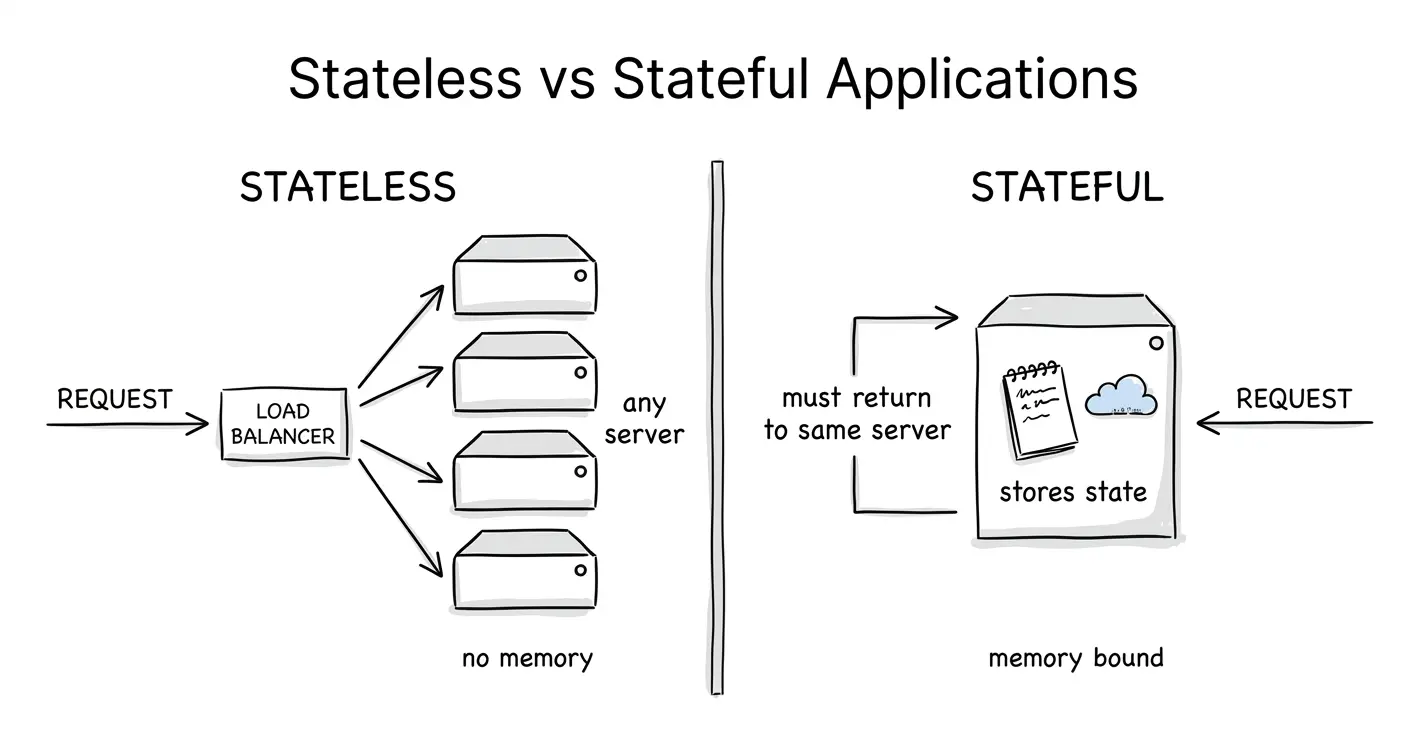
A stateless application does not rely on data stored in memory or session state within a specific running instance to serve the next request. Every request contains all the information needed to process it. Any server instance can handle any request. The application does not remember what happened before.
This does not mean the system has no state. It means the application tier does not hold state between requests. State is externalized to databases, caches, object storage, or passed in the request itself via tokens or cookies.
How stateless applications work. A client sends a request. The request includes everything needed: authentication token, user ID, parameters. The server validates the token, reads data from a database, processes the request, writes results back to the database, and returns a response. The server holds nothing in memory about this user after the response is sent. The next request from the same user can hit a different server with no impact on correctness.
Typical examples of stateless applications:
- REST APIs that authenticate via JWT tokens and read/write from databases
- Static file servers serving HTML, CSS, JavaScript
- Microservices that process requests independently and store state in external systems
- Serverless functions (AWS Lambda, Google Cloud Functions) where each invocation is isolated
Why stateless applications are easier to scale. Because any server can handle any request, you can add more servers without coordination. Load balancers distribute traffic across instances. If one instance fails, requests simply go to another instance. If traffic doubles, you spin up more instances. No session affinity required. No state migration needed.
Why stateless applications are easier to deploy. You can replace instances one at a time with zero downtime. Kubernetes rolling deployments work naturally. Blue-green deployments are straightforward. Canary releases split traffic between versions without worrying about session consistency. The system does not care which specific instances are running at any moment.
Stateless application design is the default choice in modern cloud-native architecture because it aligns with how containers, autoscaling, and distributed systems are built. Infrastructure becomes flexible. Operations become simpler. Failures become easier to handle.
What Is a Stateful Application
A stateful application depends on data, session context, or runtime state tied to a specific running instance or coordinated cluster state. Later requests depend on earlier interactions. The application holds information in memory or local storage that matters for subsequent operations. Losing the instance disrupts service continuity.
Stateful does not mean the system is poorly designed. It means the system’s behavior requires continuity that cannot be easily externalized. Some workloads fundamentally depend on active in-memory state, persistent connections, or coordinated distributed state.
How stateful applications work. A client connects to a specific server instance. The server establishes session state, maintains connection context, or accumulates runtime data in memory. Future requests from that client must reach the same server instance to access that state. If the instance disappears, the state is lost unless explicitly persisted or replicated.
Typical examples of stateful applications:
- Traditional web applications storing user sessions in server memory
- WebSocket servers maintaining live connections for chat, games, or collaboration tools
- Database systems (PostgreSQL, MySQL, MongoDB) where data persistence is the core function
- Distributed message brokers (Kafka, RabbitMQ) managing queue state and offsets
- Streaming data processors (Flink, Spark Streaming) maintaining windowed aggregations in memory
- Shopping cart systems where cart data lives only in one application node’s memory
Why stateful applications are harder to scale. You cannot arbitrarily add instances and expect load balancers to distribute traffic evenly. Clients must be routed to the correct instance where their state lives. Scaling up means migrating or replicating state. Scaling down means gracefully draining active sessions. Horizontal scaling requires state partitioning strategies.
Why stateful applications are harder to deploy. You cannot simply kill an instance and replace it. Active sessions or connections are disrupted. Rolling deployments require session draining or migration. Blue-green deployments need state synchronization. Failures require state recovery mechanisms. The cost of restarting an instance is not just downtime—it is lost continuity.
Stateful applications are necessary when the workload demands it. Databases are inherently stateful. Real-time systems often need active session state. Stream processing requires windowed state. The question is not whether to avoid stateful design, but whether the workload justifies the operational complexity.
Stateless vs Stateful: Side-by-Side Comparison
The difference between stateless and stateful is not just conceptual. It has concrete operational consequences.
| Dimension | Stateless Application | Stateful Application |
|---|---|---|
| Where state lives | External systems (database, cache, token) | Instance memory, local disk, or replicated cluster state |
| Request handling | Each request is independent | Requests depend on session or prior context |
| Instance replaceability | Any instance can serve any request | Clients must reach the correct instance |
| Load balancing | Simple round-robin or random distribution | Requires sticky sessions or connection affinity |
| Horizontal scaling | Add instances freely, immediate capacity | Requires state partitioning or replication |
| Failure recovery | Route to another instance, no state lost | State lost unless persisted or replicated |
| Deployment complexity | Rolling updates with zero downtime | Requires session draining or state migration |
| Operational risk | Low—instances are interchangeable | High—specific instances matter |
| Restart cost | Minimal—instance starts quickly | High—state must be rebuilt or restored |
| Best use cases | APIs, web services, stateless computation | Databases, message brokers, real-time systems, session-aware apps |
This comparison makes clear that the choice is not about good or bad architecture. It is about where state lives and how that placement affects system behavior.
State Exists Somewhere
No useful system is truly without state. The real question is where the state is stored.
A stateless application does not eliminate state. It externalizes state to systems designed to manage it. The application tier is stateless. The system as a whole is not.
Where state lives in a “stateless” system:
- Database: User profiles, transaction history, application data
- Cache: Session tokens, frequently accessed data (Redis, Memcached)
- Object storage: Files, images, documents (S3, GCS)
- Message queue: Asynchronous job state (SQS, Pub/Sub)
- Client-side tokens: JWT tokens carrying claims and identity
- Identity provider: OAuth state, session management (Auth0, Okta)
The stateless application reads and writes state from these external systems on every request. The advantage is that these systems are built for durability, replication, and availability. The application tier becomes simple, replaceable, and scalable. The complexity moves to specialized state management systems.
This is a strategic architectural decision. You trade off in-memory speed for operational simplicity. You trade off local state for distributed state. You push complexity into systems designed to handle it.
The stateless model works because external state systems are mature, reliable, and horizontally scalable. Databases handle replication and failover. Caches provide low-latency access. Object storage scales infinitely. The application tier becomes the dumb compute layer that orchestrates state reads and writes.
But this externalization has costs. Every request involves network calls. Latency increases. Database load increases. Consistency becomes harder when state is distributed across multiple systems. The system is only as reliable as its external dependencies.
Stateful applications keep state local to avoid these costs. But they pay with operational complexity.
Real-World Architecture Examples
Understanding the difference requires seeing how systems behave in practice.
Stateless Web API Architecture
A typical stateless web API handles requests like this:
- Client sends HTTP request with JWT token
- Load balancer routes request to any available API server instance
- API server validates JWT token (stateless authentication)
- API server queries database for user data
- API server processes business logic
- API server writes results to database
- API server returns HTTP response
- No state retained in API server memory
This architecture enables horizontal scaling, rolling deployments, and instant failure recovery. If an API server crashes, the load balancer routes the next request to another instance. The user experience is unaffected.
flowchart TB
    Client[Client]
    LB[Load Balancer]
    API1[API Server 1]
    API2[API Server 2]
    API3[API Server 3]
    DB[(Database)]
    Cache[(Redis Cache)]

    Client -->|Request + JWT| LB
    LB -->|Round Robin| API1
    LB -->|Round Robin| API2
    LB -->|Round Robin| API3

    API1 --> DB
    API2 --> DB
    API3 --> DB

    API1 --> Cache
    API2 --> Cache
    API3 --> Cache

    API1 -->|Response| Client
    API2 -->|Response| Client
    API3 -->|Response| Client

    style API1 fill:#90EE90
    style API2 fill:#90EE90
    style API3 fill:#90EE90
    style DB fill:#FFB6C1
    style Cache fill:#FFB6C1
Key characteristic: Any API server can handle any request. Servers are disposable. State lives in the database and cache.
Stateful WebSocket Game Server Architecture
A real-time multiplayer game server must maintain active session state:
- Client connects via WebSocket to specific game server instance
- Server allocates game room state in memory
- Server maintains active connections to all players in the room
- Players send game actions over persistent connections
- Server processes actions, updates game state, broadcasts to all players
- Game state lives in server memory throughout the session
This architecture requires connection affinity. Clients must connect to the same server instance where their game room exists. If the server crashes, the game session is lost.
flowchart TB
    Player1[Player 1]
    Player2[Player 2]
    Player3[Player 3]
    LB[Load Balancer
Sticky Sessions]
    Game1[Game Server 1
Room A State in Memory]
    Game2[Game Server 2
Room B State in Memory]
    DB[(Database
Persistent Game Results)]

    Player1 -->|WebSocket| LB
    Player2 -->|WebSocket| LB
    LB -.->|Sticky to Server 1| Game1

    Player3 -->|WebSocket| LB
    LB -.->|Sticky to Server 2| Game2

    Game1 -->|Save Results| DB
    Game2 -->|Save Results| DB

    Game1 -->|Broadcast Game State| Player1
    Game1 -->|Broadcast Game State| Player2

    Game2 -->|Broadcast Game State| Player3

    style Game1 fill:#FFB6C1
    style Game2 fill:#FFB6C1
    style DB fill:#90EE90
Key characteristic: Specific server instances matter. Active state lives in memory. Losing the instance disrupts the user experience.
Why Stateless Won in Modern Infrastructure
Stateless application design became the dominant pattern in cloud-native systems for operational reasons, not theoretical purity.
Containers assume disposability. Docker and Kubernetes treat containers as ephemeral. They can be killed and replaced at any time. Stateless applications fit this model perfectly. Stateful applications require persistent volumes, StatefulSets, and careful orchestration.
Autoscaling requires identical instances. Horizontal pod autoscaling adds and removes instances based on load. This works seamlessly when instances are interchangeable. Stateful applications require coordination, state partitioning, or leader election, making autoscaling complex.
Load balancers work best with stateless backends. Simple round-robin or least-connections algorithms distribute traffic evenly when any backend can handle any request. Stateful applications need sticky sessions or consistent hashing, introducing single points of failure and uneven load distribution.
Failure recovery is automatic. When a stateless instance crashes, traffic immediately shifts to healthy instances. No state is lost. No manual intervention required. Stateful instances require state recovery, replication, or failover mechanisms.
Deployments are simpler. Rolling deployments gradually replace old instances with new ones. Blue-green deployments switch traffic between versions. Canary releases test new code on a subset of traffic. All of these patterns work naturally with stateless applications. Stateful applications require draining sessions, migrating state, or synchronized upgrades.
Multi-region and multi-cloud become feasible. Stateless applications can run anywhere. Instances in different regions or clouds are equivalent. Stateful applications must carefully manage state replication, consistency, and failover across boundaries.
These operational advantages explain why REST APIs, microservices, and serverless functions are stateless by default. The architecture aligns with how modern infrastructure is built and operated.
But this does not mean stateless is always better. Externalizing state pushes complexity into databases, caches, and distributed storage systems. Network latency increases. Consistency guarantees weaken. Operational simplicity in the application tier is traded for complexity in state management systems.
Stateless applications are easier to run. But they depend entirely on external state systems. The system is only as reliable as those dependencies.
Why Stateful Still Matters
Stateful applications are harder to operate, but some workloads cannot exist without them.
Databases are fundamentally stateful. PostgreSQL, MySQL, MongoDB, Cassandra—all are stateful systems. They store durable data on disk, replicate it across nodes, and maintain consistency guarantees. You cannot make a database stateless. Data persistence is the entire point.
Message brokers manage stateful queues. Kafka maintains partitions, offsets, and replication state. RabbitMQ tracks queue depth and message delivery. These systems must preserve state across failures. Losing queue state means losing messages.
Stream processors maintain windowed state. Apache Flink and Spark Streaming compute aggregations over time windows. This requires maintaining state in memory across events. Tumbling windows, sliding windows, session windows—all depend on accumulating state over time.
Real-time systems need active session context. WebSocket servers, game servers, live collaboration tools, video conferencing systems—these maintain active connections and in-memory state. Externalizing that state to a database would destroy performance. Low-latency local state is required.
Stateful systems optimize for locality. Keeping state in memory avoids network round trips. Reading from RAM is microseconds. Reading from a remote database is milliseconds. For high-throughput, low-latency workloads, local state is necessary.
Stateful applications are not bad design. They are the right design when the workload demands it. The trade-off is operational complexity. You pay for statefulness with harder scaling, more complex deployments, and careful failure recovery. But the performance and functionality gains justify the cost.
The key insight is this: You do not eliminate state. You decide where to pay for it.
Stateless applications pay for state in external systems. Stateful applications pay for state in operational complexity. Both choices are valid. The decision depends on the workload.
Practical Decision Framework
Choosing between stateless and stateful architecture is not about following best practices. It is about understanding trade-offs and matching design to requirements.
Choose stateless when:
- Requests can be processed independently without session context
- Horizontal scaling and autoscaling are priorities
- Infrastructure elasticity and instance replaceability matter
- Deployment velocity and zero-downtime updates are critical
- External state systems (databases, caches) can meet latency requirements
- Failure recovery should be automatic and instantaneous
- Operational simplicity is more important than in-memory performance
Choose stateful when:
- Active session continuity or connection affinity is part of the product behavior
- Low-latency local state access is required for performance
- Durable coordinated state is core to the system (databases, message brokers)
- Real-time collaboration, gaming, or streaming workloads demand in-memory state
- Externalizing all state would introduce unacceptable latency or complexity
- You have the operational maturity to handle state replication, failover, and recovery
Hybrid approaches are common. Most systems are not purely stateless or stateful. An e-commerce platform might have stateless REST APIs for product catalog, a stateful shopping cart service with sticky sessions, and a stateful database backend. The architecture uses the right model for each component.
The decision is not binary. It is about placing state where it makes sense and accepting the operational consequences.
Questions
- Why can stateless applications scale horizontally more easily than stateful applications?
- What are the operational trade-offs of externalizing state to external systems like databases or caches?
Conclusion
Stateless applications are easier to scale, deploy, and recover from failures because any instance can handle any request. State is externalized to databases, caches, and storage systems, making the application tier disposable and interchangeable. This model dominates modern cloud-native infrastructure because it aligns with containers, autoscaling, and distributed systems.
Stateful applications are harder to operate because specific instances matter. State lives in memory, on local disk, or in coordinated cluster state. Losing an instance disrupts service. Scaling requires state partitioning. Deployments require session draining. But stateful design is necessary for databases, message brokers, stream processors, and real-time systems where active state is fundamental to the workload.
The distinction is not about good versus bad architecture. It is about where state lives and what that placement costs you. Stateless applications push complexity into external state systems. Stateful applications accept operational complexity for performance and functionality.
Good architecture is not about blindly choosing stateless. Good architecture is about understanding where state belongs and designing the system to handle it correctly. You do not eliminate state. You decide where to pay for it.