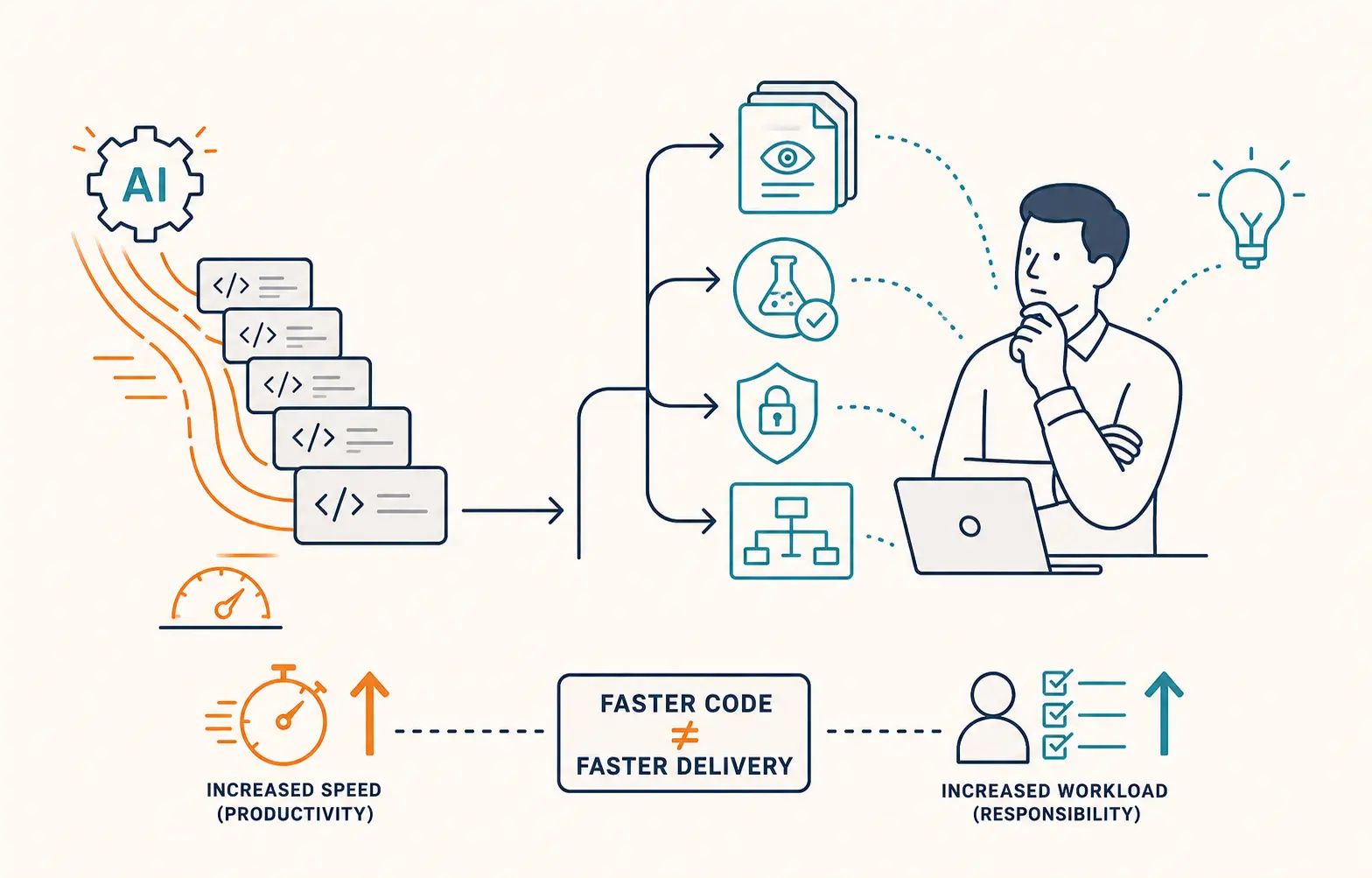
My colleagues and I have been discussing something surprising: despite pushing AI adoption hard across the company, something unexpected happened. We ship code faster, but we don’t finish work faster.
Why does this happen?
The root cause: scope and complexity. When everyone can generate code instantly, pull requests multiply. Changes grow larger—from a few files to entire new libraries. But the work doesn’t disappear; it shifts downstream.
Now I spend most of my time reviewing, testing, and verifying that code is correct, safe, and follows our architecture. Coding speed up. Human validation work up. Net result: more total effort.
There is also the hallucination problem. AI generates code that looks right but breaks real-world constraints. Our systems have strict architectural rules, and GDPR requirements that must be met. Generated code often ignores both. Someone has to catch and fix those gaps.
Simple standalone apps work great with AI-generated code. Complex systems don’t. Once you add legacy dependencies, compliance rules, and cross-team decisions, speed stops meaning much. Shipping faster code doesn’t mean shipping better systems.
Real applications need more than code. They need security, maintainability, compliance, and integration with other services. That requires judgment and experience. AI can write code, but humans understand how systems actually work and what users need.
Example: provisioning cloud resources. AI drafts architecture and generates code. But when the provider’s API changes, or a vulnerability appears, or provisioning fails in production—humans must step in. We update the code, verify compliance, and test real-world scenarios. AI doesn’t do that part yet.
What matters is reliable, standards-compliant code. That is why humans stay essential. We do the careful review, realistic testing, and thoughtful debugging that keep systems trustworthy. AI makes us faster. Humans make us right.
The future of work in the AI era
AI will continue to boost productivity, but it won’t replace human judgment. Instead, it will shift our focus from writing code to overseeing and improving it. We will spend more time on design, architecture, and quality assurance.