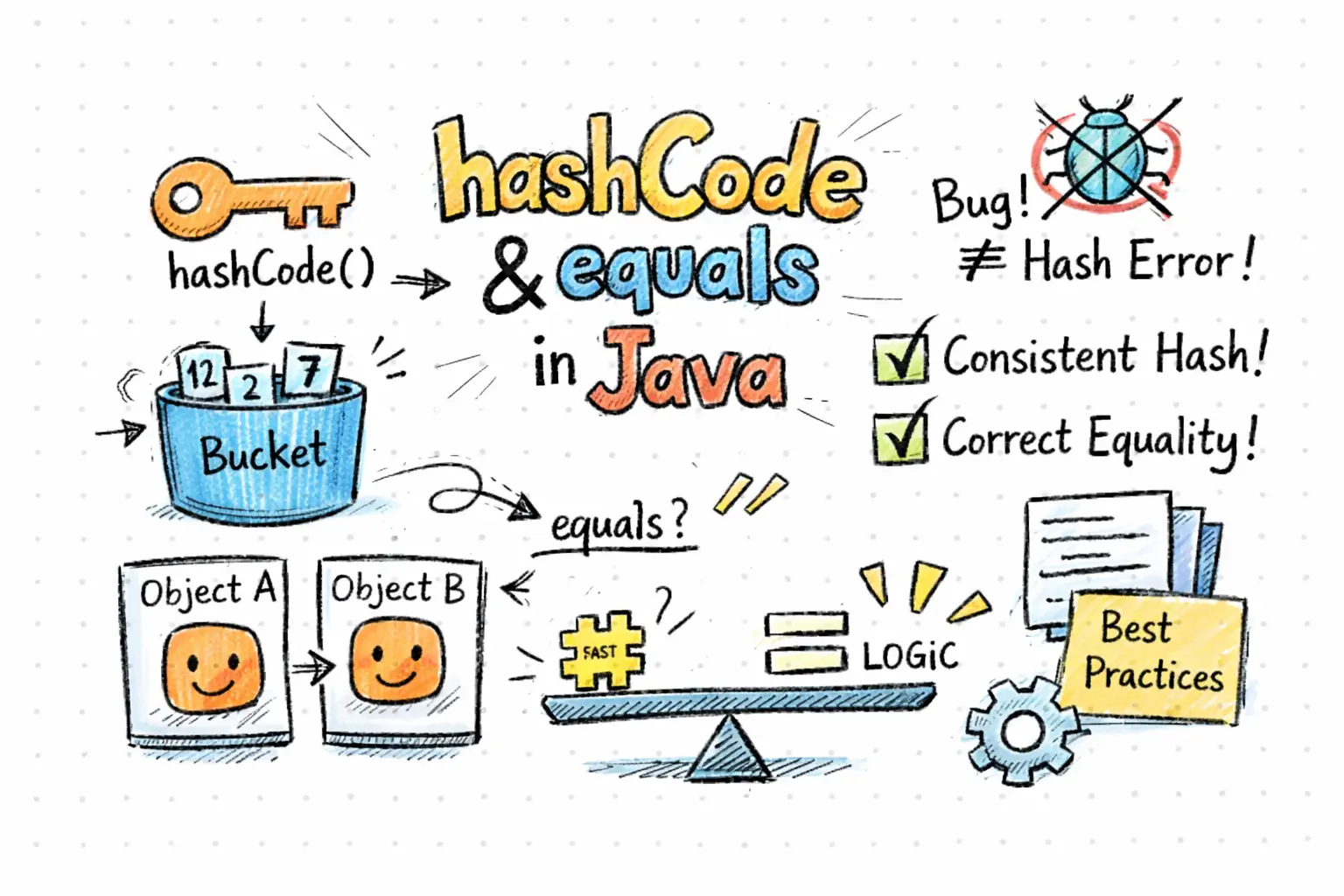
If you’ve ever used a HashMap in Java, you’ve relied on two methods you might not fully understand: equals() and hashCode(). These methods form a contract that’s easy to break and painful to debug. Override equals() without hashCode()? Your objects mysteriously disappear from the map. Use mutable fields in your hash function? Your HashMap becomes a black hole where data goes in but never comes out.
This isn’t just academic minutiae. It’s the difference between code that works and code that silently corrupts data. This guide builds understanding from first principles—what logical equality means, how hashing works, why the contract exists, and how to implement it correctly in modern Java.
Logical Equality vs Reference Equality
Java distinguishes between two forms of equality. Reference equality (==) asks: “Are these the same object in memory?” Logical equality (equals()) asks: “Do these objects represent the same value?”
String a = new String("hello");
String b = new String("hello");

System.out.println(a == b);        // false - different objects
System.out.println(a.equals(b));   // true - same value
For primitive types like int or boolean, == compares values directly because primitives aren’t objects. But for reference types, == compares memory addresses. Two distinct String objects containing “hello” are different objects (== returns false) but represent the same value (equals() returns true).
By default, Object.equals() uses reference equality—it’s just this == obj. This works for objects with identity semantics (database entities, UI components, threads). But for value objects like Point, Money, or Email, you want logical equality. Two Point instances with coordinates (10, 20) should be equal even if they’re separate objects.
When to override equals():
- Value objects where identity doesn’t matter (coordinates, email addresses, phone numbers)
- Domain objects compared by business key (User by email, Product by SKU)
- Data transfer objects (DTOs) compared by content
When NOT to override:
- Objects with strong identity (Thread, Connection, FileInputStream)
- Singletons or stateless services
- Objects compared by reference for performance or correctness reasons
The Java Contract: equals() and hashCode()
The contract between equals() and hashCode() is non-negotiable. From the Java specification:
If two objects are equal according to
equals(), they must have the same hash code.
Written formally: if a.equals(b) returns true, then a.hashCode() == b.hashCode() must return true.
The reverse is not required. Different objects can have the same hash code (called a collision), but equal objects cannot have different hash codes.
Why does this rule exist? Because hash-based collections like HashMap, HashSet, and Hashtable use hashCode() first to locate a bucket, then use equals() to find the exact object within that bucket. If equal objects have different hash codes, they land in different buckets and will never find each other.
The equals() contract requires:
- Reflexive:
x.equals(x)must be true - Symmetric: if
x.equals(y), theny.equals(x) - Transitive: if
x.equals(y)andy.equals(z), thenx.equals(z) - Consistent: multiple calls return the same value (unless object modified)
- Null safety:
x.equals(null)must be false
The hashCode() contract requires:
- Consistent: same object returns same hash code during execution (unless modified)
- Equal objects have equal hash codes: if
x.equals(y), thenx.hashCode() == y.hashCode() - Unequal objects should have different hash codes (not required, but improves performance)
Breaking these contracts leads to broken collections, lost data, and subtle bugs that surface only in production.
How HashMap Works Internally
Understanding HashMap’s internals clarifies why the contract matters. At its core, HashMap is an array of “buckets,” each holding a linked list (or tree) of entries.
Step-by-step lookup process:
1. Compute hash code:        hashCode() → 42891
2. Map to bucket index:      42891 % 16 = 11
3. Find bucket 11
4. Iterate entries in bucket 11
5. Use equals() to find exact match
ASCII diagram:
HashMap (capacity: 16)
┌────┬────────────────────────┐
│  0 │ null                   │
├────┼────────────────────────┤
│  1 │ null                   │
├────┼────────────────────────┤
│  2 │ Entry → Entry → null   │  (collision: multiple entries)
├────┼────────────────────────┤
│  3 │ null                   │
├────┼────────────────────────┤
│ .. │ ...                    │
├────┼────────────────────────┤
│ 11 │ Entry → null           │  ← hashCode() % 16 = 11
├────┼────────────────────────┤
│ .. │ ...                    │
└────┴────────────────────────┘

Each Entry contains:
{ key, value, next, hash }
Insertion (put):
public V put(K key, V value) {
    int hash = hash(key.hashCode());        // Step 1: compute hash
    int index = indexFor(hash, capacity);   // Step 2: bucket selection

    // Step 3: check if key exists
    for (Entry<K,V> e = table[index]; e != null; e = e.next) {
        if (e.hash == hash && (e.key == key || key.equals(e.key))) {
            V oldValue = e.value;
            e.value = value;                // update existing
            return oldValue;
        }
    }

    addEntry(hash, key, value, index);      // add new entry
    return null;
}
Lookup (get):
public V get(Object key) {
    int hash = hash(key.hashCode());        // Step 1
    int index = indexFor(hash, capacity);   // Step 2

    // Step 3: linear search in bucket
    for (Entry<K,V> e = table[index]; e != null; e = e.next) {
        if (e.hash == hash && (e.key == key || key.equals(e.key))) {
            return e.value;                 // found
        }
    }

    return null;                            // not found
}
Notice that hashCode() determines the bucket, while equals() confirms the exact match. If you override equals() but not hashCode(), equal objects land in different buckets and never find each other.
Collision handling:
When multiple keys hash to the same bucket, HashMap uses:
- Linked list (Java 7 and before, or small buckets in Java 8+)
- Balanced tree (Java 8+, when bucket has 8+ entries)
This keeps worst-case lookup at O(log n) instead of O(n) during heavy collisions.
Default Behavior: Object Class
If you don’t override equals() and hashCode(), you get the defaults from Object:
// From java.lang.Object
public boolean equals(Object obj) {
    return (this == obj);  // reference equality
}

public native int hashCode();  // identity-based, typically memory address
Default equals() uses ==, meaning two objects are equal only if they’re the exact same instance. Two Person objects with name “Alice” are not equal.
Default hashCode() typically derives from the object’s memory address (implementation-defined). Each distinct object gets a unique hash code.
When the default is correct:
class DatabaseConnection {
    private Socket socket;
    private String connectionId;

    // Don't override equals/hashCode
    // Each connection is unique by identity
}

// Usage
Map<DatabaseConnection, Long> connectionTimes = new HashMap<>();
DatabaseConnection conn1 = new DatabaseConnection();
DatabaseConnection conn2 = new DatabaseConnection();

connectionTimes.put(conn1, System.currentTimeMillis());
System.out.println(connectionTimes.get(conn1));  // Works: same object
System.out.println(connectionTimes.get(conn2));  // null: different object
When the default is wrong:
class Point {
    private int x, y;

    Point(int x, int y) {
        this.x = x;
        this.y = y;
    }

    // No equals/hashCode override - BUG
}

// Bug demonstration
Set<Point> points = new HashSet<>();
points.add(new Point(10, 20));
System.out.println(points.contains(new Point(10, 20)));  // false - BUG!

// Two Point(10,20) objects are different instances,
// so contains() fails even though they represent the same coordinate
The rule: override equals() when logical equality differs from reference equality. And when you override equals(), you must override hashCode().
Common Mistakes That Break HashMap
Mistake 1: Override equals() but not hashCode()
This is the most common error. It violates the contract and breaks all hash-based collections.
class User {
    private String email;

    User(String email) { this.email = email; }

    @Override
    public boolean equals(Object obj) {
        if (this == obj) return true;
        if (!(obj instanceof User)) return false;
        User other = (User) obj;
        return email.equals(other.email);
    }

    // BUG: No hashCode() override
}

// Broken behavior
Map<User, String> users = new HashMap<>();
User alice1 = new User("alice@example.com");
User alice2 = new User("alice@example.com");

users.put(alice1, "Alice");

// This should return "Alice" but returns null!
System.out.println(users.get(alice2));  // null - BUG!

// Why: alice1 and alice2 are equal but have different hash codes,
// so they land in different buckets. HashMap never finds alice1 when
// looking up alice2.
Fix: Always override both methods together.
Mistake 2: Using Mutable Fields in hashCode()
Hash codes must remain constant while an object is stored in a hash collection. If the hash code changes, the object becomes unreachable.
class MutablePoint {
    private int x, y;

    MutablePoint(int x, int y) {
        this.x = x;
        this.y = y;
    }

    public void setX(int x) { this.x = x; }
    public void setY(int y) { this.y = y; }

    @Override
    public boolean equals(Object obj) {
        if (!(obj instanceof MutablePoint)) return false;
        MutablePoint p = (MutablePoint) obj;
        return x == p.x && y == p.y;
    }

    @Override
    public int hashCode() {
        return Objects.hash(x, y);  // BUG: uses mutable fields
    }
}

// Black hole bug
Set<MutablePoint> points = new HashSet<>();
MutablePoint p = new MutablePoint(10, 20);
points.add(p);

System.out.println(points.contains(p));  // true

p.setX(15);  // Modifies fields used in hash code

// Now the point is lost! It's still in the set, but in the wrong bucket
System.out.println(points.contains(p));  // false - BLACK HOLE BUG!

// The set thinks it has 1 element, but contains() returns false
// You can't remove it, you can't find it, but iteration shows it
System.out.println(points.size());       // 1
points.forEach(System.out::println);     // Prints the point
Fix: Only use immutable fields in hashCode(), or make your entire class immutable.
Mistake 3: Inconsistent equals() and hashCode() Logic
Both methods must use the exact same fields.
class Product {
    private String sku;
    private String name;

    @Override
    public boolean equals(Object obj) {
        if (!(obj instanceof Product)) return false;
        Product p = (Product) obj;
        return sku.equals(p.sku);  // Only uses sku
    }

    @Override
    public int hashCode() {
        return Objects.hash(sku, name);  // BUG: uses sku AND name
    }
}

// Broken behavior
Product p1 = new Product("SKU-123", "Widget");
Product p2 = new Product("SKU-123", "Gadget");

System.out.println(p1.equals(p2));       // true (same sku)
System.out.println(p1.hashCode() == p2.hashCode());  // false - VIOLATION!
Fix: Use the exact same fields in both methods.
Best Practices for Correct Implementation
1. Choose the right fields:
Include only fields that define logical equality. Typically:
- Value objects: all fields
- Entities: business key fields (ID, SKU, email)
- Exclude: derived fields, transient state, timestamps (unless they define equality)
2. Make classes immutable when possible:
public final class Email {
    private final String address;

    public Email(String address) {
        this.address = address.toLowerCase();
    }

    public String getAddress() { return address; }

    @Override
    public boolean equals(Object obj) {
        if (this == obj) return true;
        if (!(obj instanceof Email)) return false;
        Email other = (Email) obj;
        return address.equals(other.address);
    }

    @Override
    public int hashCode() {
        return address.hashCode();
    }
}
3. Use Objects.hash() for convenience:
@Override
public int hashCode() {
    return Objects.hash(field1, field2, field3);
}
This is simple and correct. It generates hash codes using a formula similar to Arrays.hashCode().
Alternative: Prime multiplication (manual, optimized):
@Override
public int hashCode() {
    int result = 17;
    result = 31 * result + field1.hashCode();
    result = 31 * result + field2.hashCode();
    result = 31 * result + field3;
    return result;
}
Prime multiplication (31 is traditional) reduces collisions. Use this when profiling shows Objects.hash() is a bottleneck (rare).
4. Standard equals() pattern:
@Override
public boolean equals(Object obj) {
    if (this == obj) return true;                    // Optimization
    if (obj == null || getClass() != obj.getClass()) return false;

    MyClass other = (MyClass) obj;
    return Objects.equals(field1, other.field1)
        && Objects.equals(field2, other.field2)
        && field3 == other.field3;
}
5. Use instanceof carefully:
// Strict: class must match exactly
if (obj == null || getClass() != obj.getClass()) return false;

// Lenient: allows subclasses (breaks symmetry if subclass adds fields)
if (!(obj instanceof MyClass)) return false;
Prefer exact class match (getClass()) unless you have a specific reason to allow subclasses.
6. Handle nulls safely:
Use Objects.equals(a, b) which handles null values:
Objects.equals(null, null)     // true
Objects.equals("a", null)      // false
Objects.equals(null, "a")      // false
Objects.equals("a", "a")       // true
Modern Java Solutions
Modern Java provides tools to generate correct implementations automatically.
Java Records (Java 14+)
Records are immutable data carriers with automatic equals(), hashCode(), and toString():
public record Point(int x, int y) {}

// Equivalent to:
public final class Point {
    private final int x;
    private final int y;

    public Point(int x, int y) {
        this.x = x;
        this.y = y;
    }

    // Auto-generated equals(), hashCode(), toString()
    // Auto-generated getters: x(), y()
}

// Usage
Point p1 = new Point(10, 20);
Point p2 = new Point(10, 20);

System.out.println(p1.equals(p2));  // true
System.out.println(p1.hashCode() == p2.hashCode());  // true

Map<Point, String> map = new HashMap<>();
map.put(p1, "Origin");
System.out.println(map.get(p2));  // "Origin" - works correctly!
Records are perfect for DTOs, value objects, and any immutable data structure.
Lombok @EqualsAndHashCode
For pre-Java 14 projects or complex classes:
import lombok.EqualsAndHashCode;

@EqualsAndHashCode
public class User {
    private String email;
    private String name;

    @EqualsAndHashCode.Exclude
    private LocalDateTime lastLogin;  // Exclude from equality
}
Lombok generates methods at compile time. Use @EqualsAndHashCode.Exclude for fields that shouldn’t affect equality.
IDE Generation
IntelliJ IDEA and Eclipse can generate correct implementations:
- IntelliJ: Code → Generate →
equals()andhashCode() - Eclipse: Source → Generate
hashCode()andequals()
Choose fields, pick a generation strategy, and review the output.
When NOT to Use Automation
Don’t auto-generate for:
- Entities with database IDs: Use only the ID, not all fields
- Classes with complex equality logic: Custom business rules require manual implementation
- Performance-critical code: Hand-tuned hash functions may be necessary
Questions
1. What happens if you put an object in a HashMap, then modify a field used in hashCode()?
The object becomes unreachable. It’s stored in a bucket determined by the old hash code, but lookups use the new hash code and search the wrong bucket. The object is “lost” in the map—it’s still there (size includes it), but get() and contains() return null/false. This is why hash code fields must be immutable.
2. Why does the contract allow unequal objects to have the same hash code?
Perfect hashing (unique hash codes for all objects) is mathematically impossible for unbounded domains. Hash codes are int (32 bits, ~4 billion values), but there are infinitely many possible Strings. Collisions are inevitable. HashMap handles them with buckets containing multiple entries. Good hash functions minimize collisions, but they can’t eliminate them.