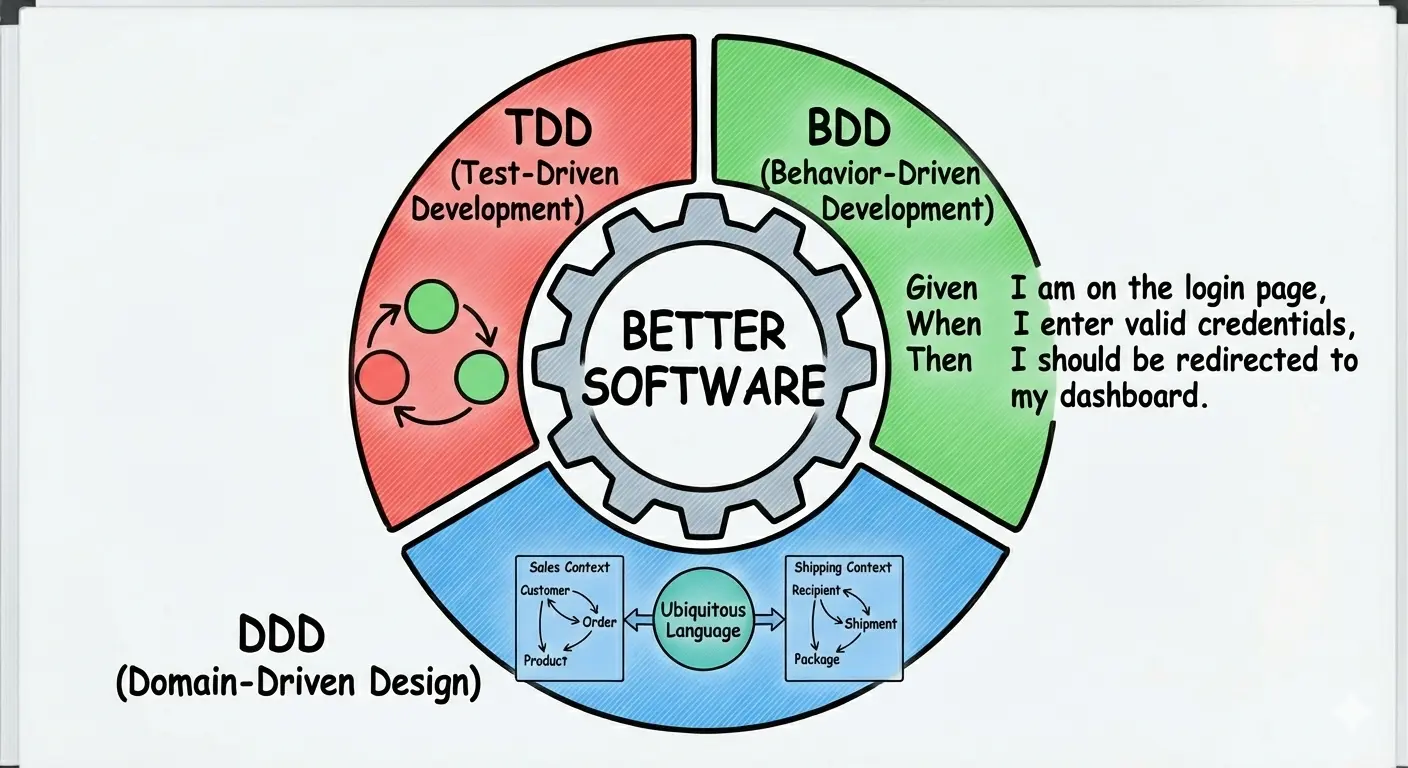
Test-Driven Development (TDD), Behavior-Driven Development (BDD), and Domain-Driven Design (DDD) are three influential practices that address different layers of software development complexity. While often mentioned together, each serves distinct purposes and operates at different levels of abstraction. This guide provides practical guidance on when and how to apply each practice, how they complement each other, and common pitfalls to avoid.
At a glance
- TDD focuses on code quality through test-first development at the unit level
- BDD bridges technical and business perspectives through behavior specifications
- DDD tackles complex business domains through strategic design and modeling
- Each practice operates at different layers: code, feature, and architecture
- They complement each other in a layered approach: DDD informs BDD, BDD informs TDD
- Success requires understanding when to apply each practice and avoiding common anti-patterns
- Start with the practice that addresses your primary pain point, then layer others as needed
Definitions and Core Principles
Test-Driven Development (TDD) was popularized by Kent Beck in the early 2000s as part of Extreme Programming. TDD follows a simple red-green-refactor cycle: write a failing test, make it pass with minimal code, then refactor for quality. The core principle is that tests drive the design of the code, leading to better interfaces and higher confidence in changes.
Key principles of TDD:
- Write tests before implementation code
- Take small steps with immediate feedback
- Refactor continuously while maintaining test coverage
- Use tests as executable documentation
Behavior-Driven Development (BDD) emerged from the work of Dan North around 2003 as an evolution of TDD. BDD addresses the disconnect between technical tests and business requirements by using natural language specifications. It emphasizes collaboration between developers, testers, and business stakeholders through shared understanding of system behavior.
Key principles of BDD:
- Focus on behavior rather than implementation
- Use ubiquitous language understood by all stakeholders
- Drive development from the outside-in through scenarios
- Ensure specifications serve as living documentation
Domain-Driven Design (DDD) was introduced by Eric Evans in his 2003 book “Domain-Driven Design: Tackling Complexity in the Heart of Software.” DDD provides strategic and tactical patterns for modeling complex business domains. It emphasizes close collaboration between domain experts and developers to create software that reflects the business reality.
Key principles of DDD:
- Place the domain model at the center of design
- Collaborate closely with domain experts
- Use bounded contexts to manage complexity
- Evolve the model through continuous learning
Focus Areas and Artifacts
Each practice operates at different levels of granularity and produces distinct artifacts that serve different stakeholders and purposes.
Test Driven Development (TDD)
TDD operates at the code level and produces unit tests, integration tests, and well-designed APIs. The primary artifacts are test suites that verify individual components and their interactions. Common tools include JUnit (Java), pytest (Python), Jest (JavaScript), and RSpec (Ruby). TDD ensures that code is testable, loosely coupled, and adheres to single responsibility principles.
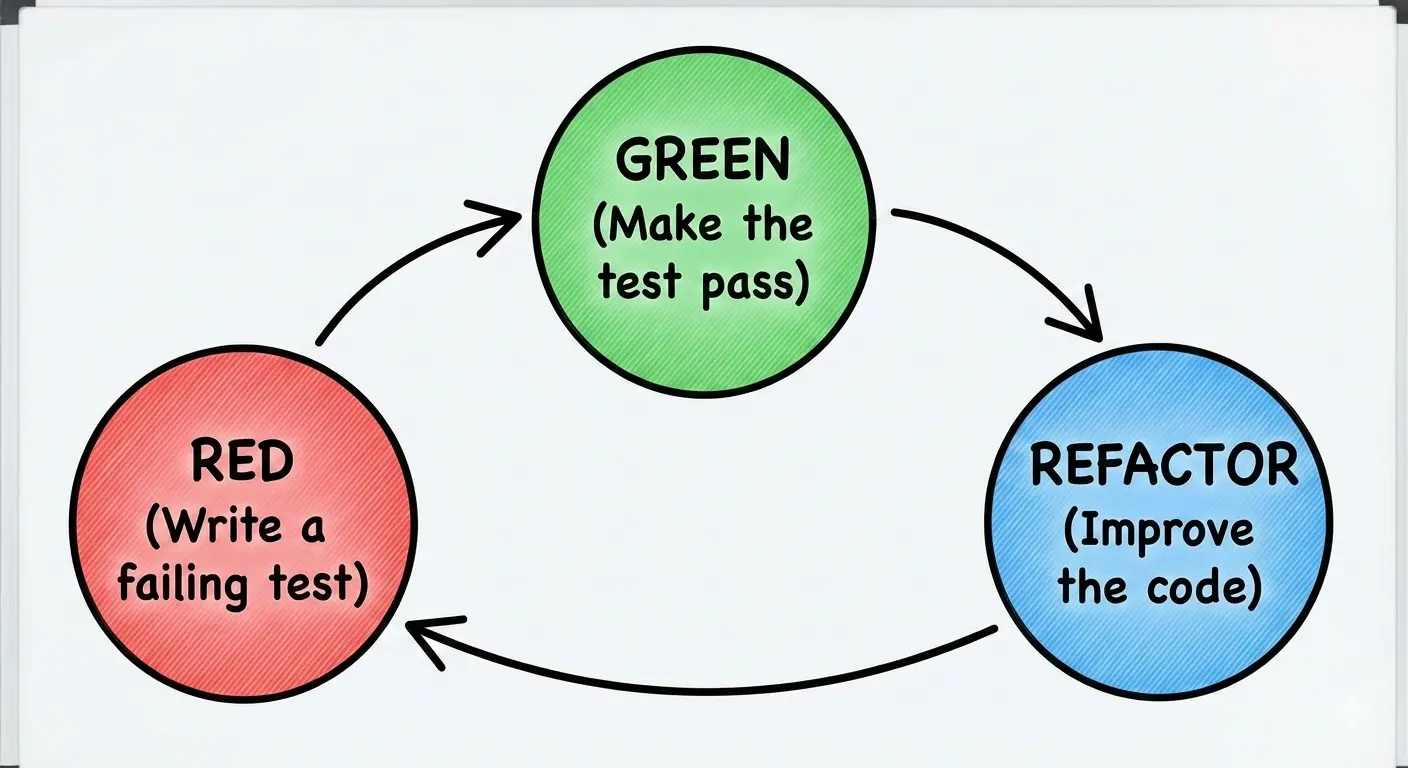
The TDD cycle is often summarized as Red-Green-Refactor:
- Red: Write a test that fails (because the functionality doesn’t exist yet).
- Green: Write the simplest code possible to make the test pass.
- Refactor: Improve the code’s structure and readability without changing its behavior.
Behavior Driven Development (BDD)
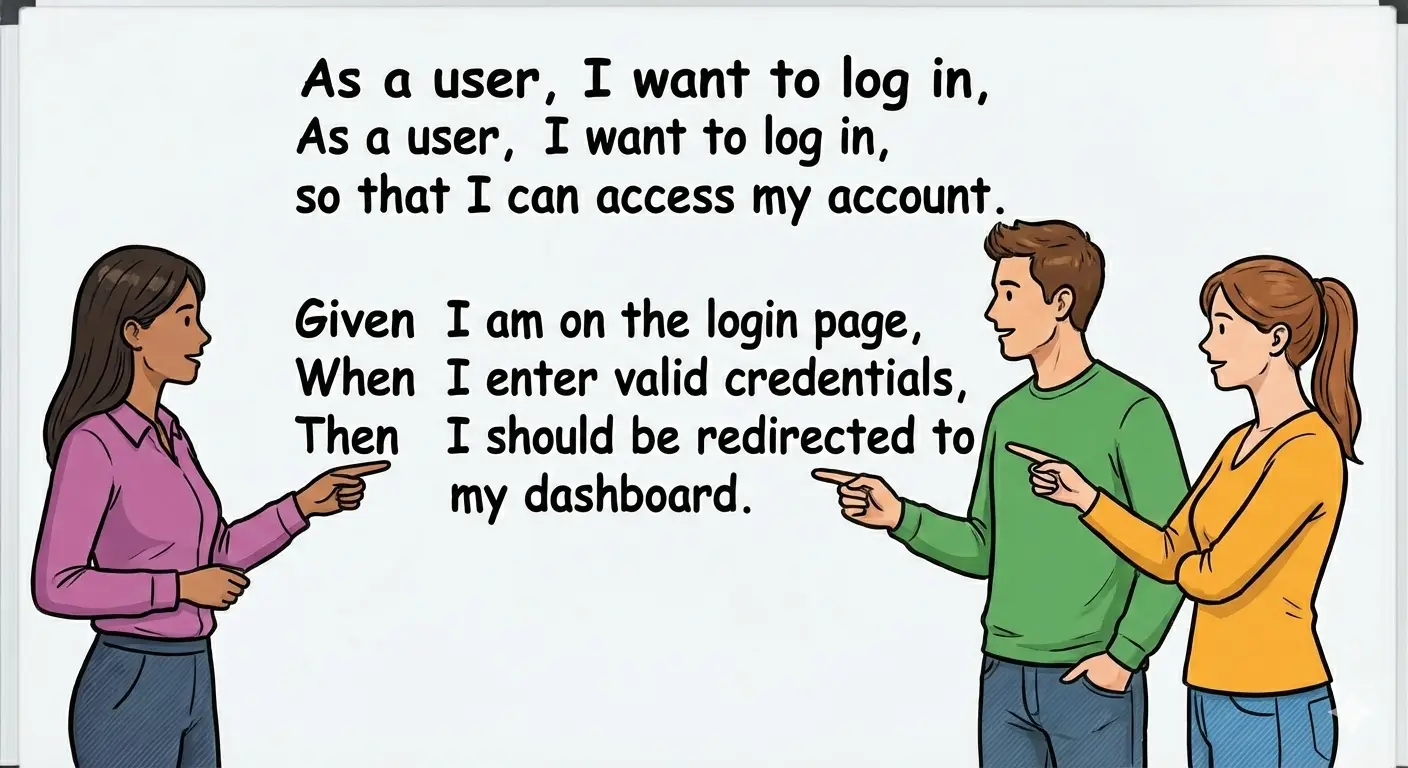
BDD operates at the feature level and produces executable specifications written in natural language. Key artifacts include feature files, step definitions, and living documentation. BDD focuses on the behavioral specification of software and encourages the use of a common language that all team members can understand.
BDD uses a simple “Given-When-Then” format to describe the behavior of a system from the user’s perspective. This shared understanding helps to ensure that the software being built is the software that the business actually needs.
Example BDD specification:
Feature: Order Processing
  As a customer
  I want to place orders for products
  So that I can purchase items I need

  Scenario: Calculate order total with multiple items
    Given I have an empty shopping cart
    When I add 2 widgets at $10.00 each
    And I add 1 gadget at $15.00
    Then the order total should be $35.00
Domain-Driven Design (DDD)
DDD operates at the domain/architecture level and produces domain models, bounded context maps, and architectural decisions. Artifacts include entity and value object definitions, aggregate designs, domain services, and context mapping diagrams. DDD modeling is often done through Event Storming sessions and collaborative design workshops rather than specific tools.
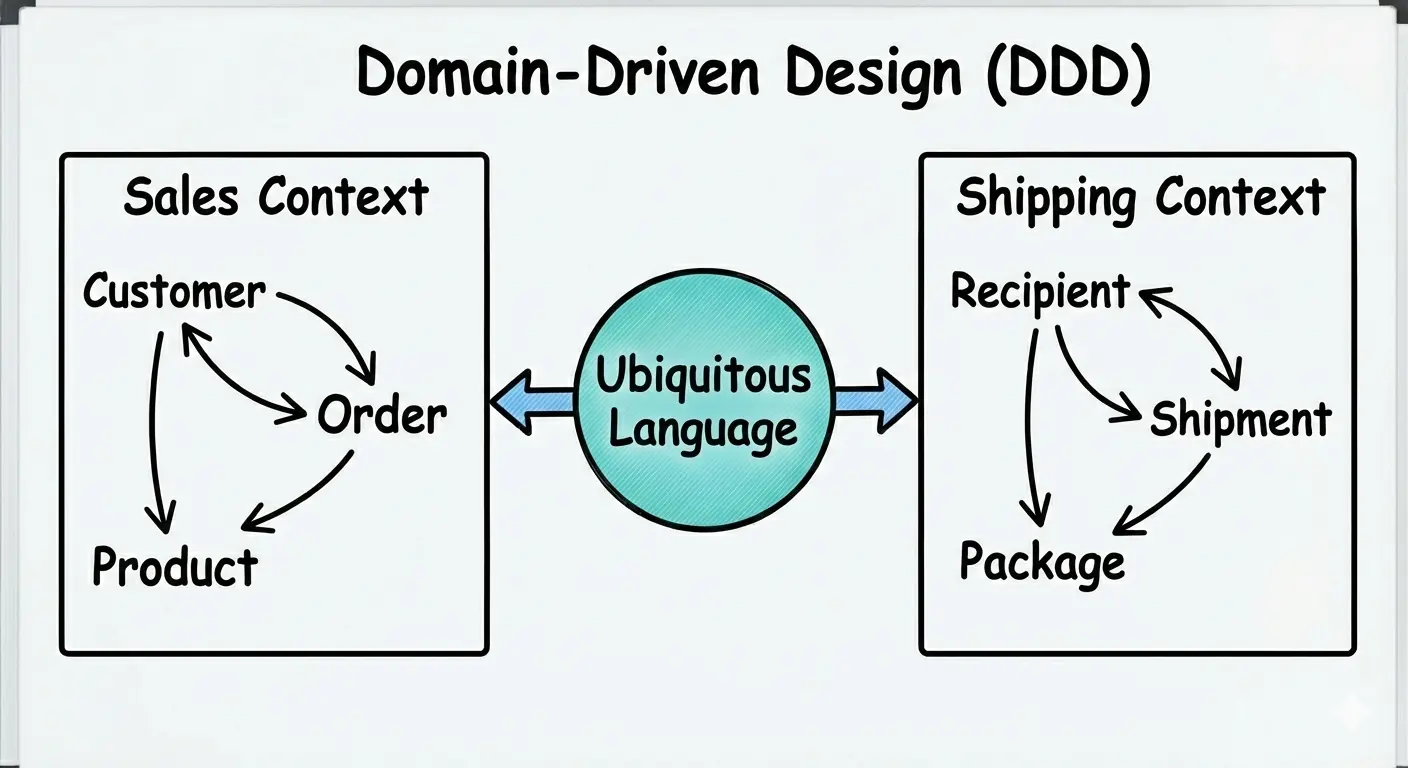
A key concept in DDD is the Ubiquitous Language, a common language used by both technical and non-technical team members to describe the domain model. The image below shows two different Bounded Contexts (Sales and Shipping) that share this ubiquitous language.
When and How to Apply Each Practice
Understanding when to apply each practice depends on your project’s primary challenges and constraints. Each practice addresses different failure modes and provides different types of value.
Apply TDD when you need:
- High confidence in code quality and regression prevention
- Better API design through test-first thinking
- Rapid feedback during development
- Legacy code modernization with safety nets
TDD works best for projects with well-understood requirements where the main challenge is implementation quality. It’s particularly valuable for libraries, utilities, and algorithmic code where correctness is paramount. TDD can be challenging for UI-heavy applications or when requirements are highly uncertain.
Common TDD failure modes it prevents:
- Regression bugs in existing functionality
- Poorly designed APIs that are hard to test
- Lack of confidence when refactoring
- Over-engineering without clear requirements
Apply BDD when you need:
- Better alignment between business requirements and implementation
- Improved communication between technical and non-technical stakeholders
- Living documentation that stays current with the system
- End-to-end verification of user workflows
BDD is ideal for projects where the main challenge is understanding and implementing complex business rules. It excels in domains with many stakeholders, regulatory requirements, or where user experience is critical. BDD requires significant investment in collaboration and can be overkill for purely technical systems.
Common BDD failure modes it prevents:
- Building features that don’t deliver business value
- Misunderstanding of requirements leading to rework
- Disconnect between tests and actual user needs
- Documentation that becomes outdated
Apply DDD when you need:
- Taming complexity in large, long-lived systems
- Better alignment between software structure and business structure
- Effective team organization around business capabilities
- Evolution of the system as business understanding grows
DDD is most valuable for complex domains with intricate business rules, multiple stakeholders, and evolving requirements. It’s less useful for simple CRUD applications or technical infrastructure where business complexity is minimal. DDD requires significant upfront investment in domain understanding and modeling.
Common DDD failure modes it prevents:
- Technical architecture that doesn’t reflect business reality
- Big ball of mud as complexity grows
- Team conflicts due to unclear boundaries
- Inability to adapt to changing business needs
Integration Strategies and Complementarity
The three practices complement each other in a layered approach, with each informing the others in a natural progression from business understanding to implementation.
DDD → BDD → TDD workflow:
-
Start with DDD to understand the business domain and identify bounded contexts. Use collaborative modeling sessions to create a shared understanding of the problem space. Define aggregates, entities, and domain services that capture business rules.
-
Apply BDD to specify how the domain concepts manifest as user-visible behavior. Write scenarios that exercise domain boundaries and verify business rules. Use the ubiquitous language from DDD in BDD specifications.
-
Use TDD to implement the components identified through BDD scenarios. Let the failing BDD scenarios drive the creation of unit tests. Refactor implementation while keeping both BDD and TDD tests green.
Example integration:
DDD Session Output:
Bounded Context: Order Management
Aggregate: Order (contains OrderItems)
Business Rule: Orders cannot be modified after confirmation
Domain Event: OrderConfirmed
BDD Scenario:
Scenario: Prevent modification of confirmed orders
  Given I have a confirmed order
  When I try to add an item to the order
  Then I should receive an error message
  And the order should remain unchanged
TDD Implementation:
def test_confirmed_order_rejects_modifications():
    order = Order(customer_id=CustomerId("123"))
    order.add_item(product, Quantity(1))
    order.confirm()

    with pytest.raises(InvalidOperationError):
        order.add_item(another_product, Quantity(1))
Alternative integration patterns:
- BDD-first approach: Start with user scenarios to understand what to build, then use TDD for implementation
- TDD-informed DDD: Use TDD learnings about system boundaries to refine domain model
- Selective application: Apply only the practices that address your current pain points
The key is maintaining traceability from business concepts (DDD) through behavior specifications (BDD) to implementation tests (TDD). This creates a coherent feedback loop where insights at any level can inform improvements at others.
Common Pitfalls and Anti-Patterns
Each practice has characteristic failure modes that occur when fundamental principles are misunderstood or misapplied.
TDD Anti-Patterns:
Test-After Development: Writing tests after implementation defeats the design benefits of TDD. Tests become verification rather than design tools, often resulting in brittle tests that are hard to maintain.
Over-Testing: Testing every getter, setter, and trivial method creates maintenance burden without value. Focus on behavior and business rules rather than implementation details.
Mocking Everything: Excessive mocking can lead to tests that pass while the system fails. Use real objects when possible and reserve mocks for external dependencies or complex collaborators.
BDD Anti-Patterns:
UI Test Scripting: Using BDD tools to write detailed UI automation tests misses the point of behavior specification. BDD scenarios should focus on business outcomes, not click sequences.
Technical Language in Scenarios: Writing scenarios that require technical knowledge excludes non-technical stakeholders. Use domain language that business experts understand and can validate.
Scenario Explosion: Creating exhaustive scenarios for every edge case makes the suite unmaintainable. Focus on key examples that illustrate business rules and happy paths.
DDD Anti-Patterns:
Big Design Up Front: Trying to create the perfect domain model before implementation leads to analysis paralysis. DDD models should evolve through iterative development and learning.
Anemic Domain Models: Creating models that are just data containers without behavior defeats the purpose of domain modeling. Ensure that business logic lives in domain objects, not service layers.
Context-Free Modeling: Applying DDD patterns without considering bounded contexts leads to over-complicated models. Not every part of the system needs rich domain modeling.
Successful application requires:
- Understanding the problem each practice solves
- Applying practices incrementally rather than all at once
- Adapting practices to your context rather than following dogma
- Measuring value through reduced defects, improved communication, or better design
- Stopping when the practice doesn’t provide value for your situation
Design and Trade-offs
| Aspect | TDD | BDD | DDD |
|---|---|---|---|
| Primary Focus | Code quality and design | Business behavior verification | Domain modeling and architecture |
| Granularity | Unit/component level | Feature/scenario level | System/context level |
| Stakeholders | Developers, QA | Business analysts, developers, testers | Domain experts, architects, developers |
| Time Investment | Medium (20-30% overhead) | High (requires collaboration) | Very High (significant upfront modeling) |
| Learning Curve | Moderate | Moderate to High | High |
| Best ROI Context | Stable requirements, quality focus | Complex business rules, stakeholder alignment | Large systems, complex domains |
| Risk When Skipped | Technical debt, bugs | Wrong features built | Architectural complexity, maintainability issues |