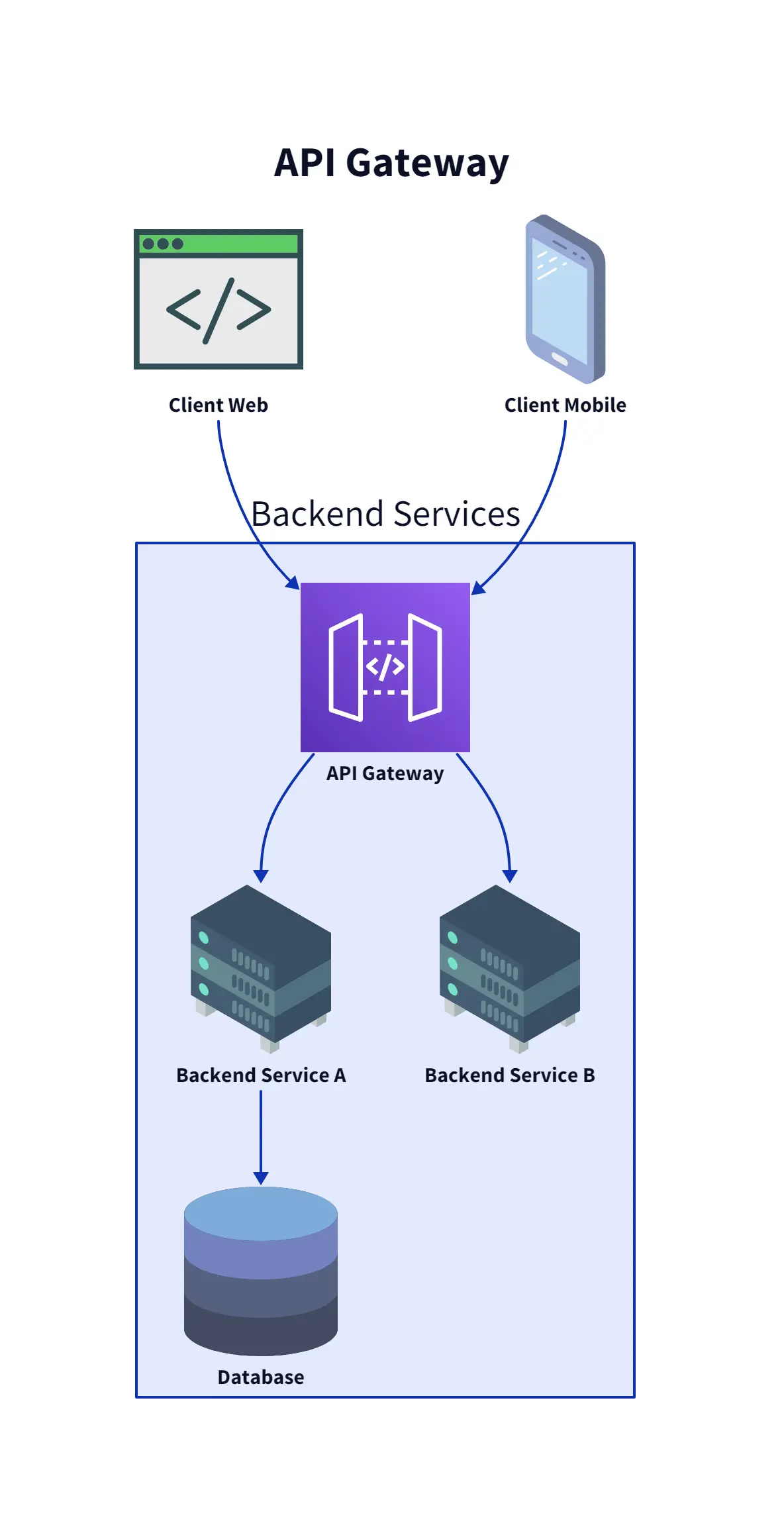
In today’s world of microservices, a simple client request might fan out into a dozen backend calls—user data from one service, product data from another, payment validation from a third. Without structure, this becomes chaos. That’s where the API Gateway comes in: the single front door to your system. It hides the messy sprawl of services, enforces policies, and keeps the system predictable under load.
Why an API Gateway Matters
Think of it as an airport control tower. Flights (requests) arrive from different directions, but the tower decides where they land, in what order, and under what rules. Without it, the runway becomes a free-for-all. For microservices, the API Gateway is that control tower—handling routing, security, traffic shaping, and visibility.
Core Design Principles
At a high level, API Gateways are built around these principles:
- Reverse proxy at the edge: All traffic goes through one choke point, then gets forwarded to the right backend.
- Intelligent routing: Requests are steered by paths, headers, or even traffic-splitting for canary releases.
- Service discovery: The gateway asks “who’s alive?” instead of hardcoding service addresses.
- Protocol translation: HTTP in, gRPC out; WebSocket upgrades; whatever the system demands.
- Resilience: Circuit breakers, retries, and timeouts so one bad service doesn’t take down the system.
- Horizontal scalability: Gateways must scale linearly under load, often deployed in clusters.
Key Components You’ll Find in a Gateway
Instead of just plumbing, each gateway comes with specialized layers:
- Routing Engine – the traffic cop, mapping incoming requests to the right service.
- Security Module – authentication, authorization, API keys, JWTs, OAuth, and DDoS protection.
- Traffic Control – load balancing, rate limiting, caching, and request/response transformation.
- Observability Layer – logs, metrics, distributed tracing; the visibility engineers need to debug complex flows.
- Policy Engine – enforces governance: versioning, schema validation, and business rules.
Benefits at the System Level
- Unified interface: Clients only talk to one endpoint.
- Centralized security: A smaller, hardened attack surface.
- Operational leverage: Easier monitoring, analytics, and debugging.
- Developer velocity: New services can be added without changing client apps.
Performance gains can be tangible: cached reads cut backend load in half, connection pooling shaves latency, and aggregation reduces client round trips.
Trade-offs You Can’t Ignore
Every gateway introduces new risks:
- A single point of failure if deployed poorly.
- Latency tax of 5–15 ms per hop.
- Operational complexity—a gateway is its own subsystem.
- Configuration sprawl when dozens of routing rules and policies pile up.
Mitigation comes from good design: multi-region deployment, health checks, infrastructure-as-code, and avoiding lock-in with open-source stacks like Kong or Envoy.
Common Patterns
- Edge Gateways for public traffic.
- Internal Gateways for service-to-service calls.
- Micro Gateways colocated with services in a service mesh.
Enterprises often mix and match: a heavy edge gateway for the outside world, lightweight sidecars internally.
Design Trade-offs in Practice
| Approach | Strengths | Weaknesses | Where It Fits |
|---|---|---|---|
| Monolithic Gateway | Simplicity, centralized control | Scaling bottleneck | Small to medium systems |
| Federated Gateways | Autonomy per domain | Coordination overhead | Large organizations |
| Sidecar Pattern | Granular control, resilience | Resource cost | Service mesh |
| Edge + Internal | Clear separation | Higher complexity | Hybrid/multi-cloud |
Closing Thoughts
An API Gateway isn’t just a router. It’s a strategic control plane for your system—deciding how traffic flows, how policies are enforced, and how failures are contained. Done right, it accelerates development and keeps systems sane at scale. Done wrong, it becomes a choke point. The design question is not whether to have one, but how to architect it so it balances control with simplicity.